

What NASA and the New ACSM Guidelines Say About Building Strength and Muscle
Summer is right around the corner here in New Orleans. The weather is warming up, the festivals are going strong, and people are starting to think about how they feel — and how they look — in less clothing.
So let's talk about something that's been making news in both the fitness world and outer space this week, because they're more connected than you'd think.
Right now, four astronauts on NASA's Artemis II mission are orbiting the moon in an Orion Capsule about the size of a minivan. Every single day, each of them spends 30 minutes working out — in zero gravity — using a single piece of equipment roughly the size of a carry-on suitcase.
That device is called a flywheel. And the science behind why NASA chose it is the same science the American College of Sports Medicine just put at the center of their updated 2026 resistance training guidelines.
That science has everything to do with how you train if your goal is to get stronger, build muscle, and build the kind of physique that carries you well — not just through summer, but for the long haul.
First — What Are the New ACSM Guidelines Actually Saying About Strength and Hypertrophy?
In March 2026, the American College of Sports Medicine published its first updated resistance training Position Stand since 2009, synthesizing findings from 137 systematic reviews representing more than 30,000 participants.
Here's what matters for your training goals.
For Strength: Load Is King
For strength, the ACSM recommends lifting heavier loads — at or above 80% of your one-repetition maximum — for 2 to 3 sets per exercise.
This isn't surprising, but it's worth saying clearly: if you want to get stronger, you have to challenge your muscles with meaningful resistance. Heavier loading recruits the high-threshold motor units — the ones responsible for maximal force production — that simply don't get fully activated with light weights.
Load remains the dominant variable for strength development, reflecting the recruitment of high-threshold motor units that are essential for maximal force production.
For Hypertrophy (Muscle Growth): Effort Beats Load
This is where the updated guidelines break from old thinking in a big way.
For hypertrophy, the 2026 Position Stand confirms that loads from 30 to 100% of your one-rep max produce comparable muscle growth, provided sets are taken close enough to failure.
Read that again. Light weights, moderate weights, heavy weights — they can all build muscle equally well, as long as you're working hard enough.
The 2026 position stand specifically notes that hypertrophy was not meaningfully changed by loads ranging from low to high when effort was sufficient. Load is one variable inside a bigger ecosystem that includes effort, volume, exercise selection, range of motion, and adherence.
So what does drive hypertrophy? Two things more than anything else: volume (how many sets you do per muscle group per week — the guidelines support 10 or more) and training close to failure. The ACSM recommends stopping about 2 to 3 reps short of failure — called "reps in reserve" — as sufficient and preferable for most people.
Coach's note on failure: I tell my clients to train to technical failure — meaning when your form breaks down, you stop. The moment you start compensating, you're recruiting muscles you don't intend to work, which over time creates the muscular imbalances we're trying to avoid in the first place.
Now — What Does NASA Have to Do With This?
Here's where it gets interesting.
The Artemis II astronauts are currently using a flywheel exercise device aboard the Orion spacecraft — the first time a flywheel has ever been used in space. The crew spends 30 minutes daily doing squats and deadlifts using cables on the device.
NASA didn't pick the flywheel because it was cheap or easy. They picked it because the science on what it does to muscle tissue is exceptional — especially in situations where you can't load the body with traditional gravity-dependent weights.
So What Is a Flywheel?
A flywheel device works on a simple principle: a cord wraps around a spinning disc (think of a yo-yo). When you pull the cord — doing your squat, your row, your deadlift — you accelerate that disc. When the movement ends, the disc keeps spinning and pulls the cord back — which means your muscles have to resist and decelerate that force on the way back.
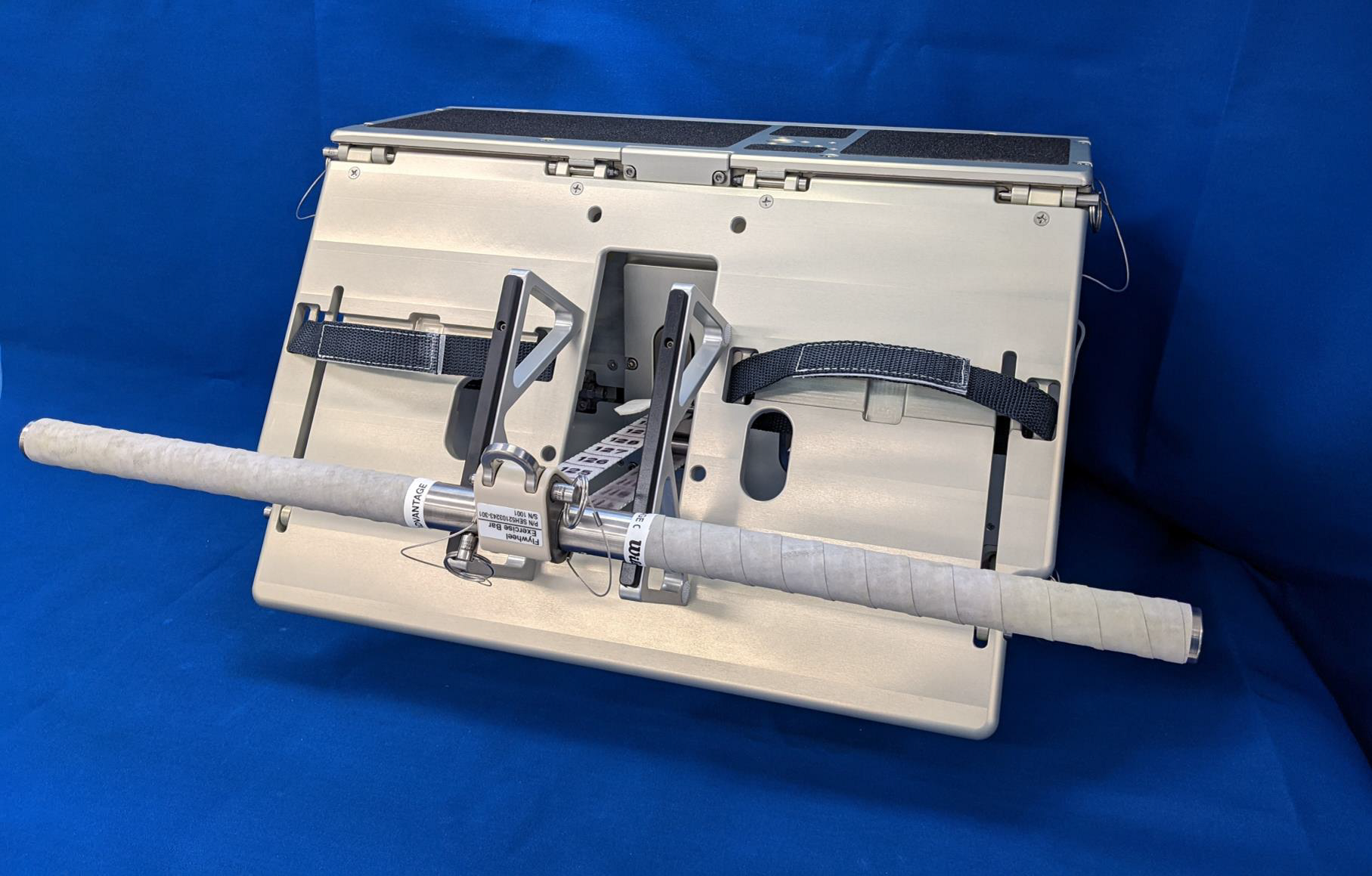
That resistance on the way back is called eccentric overload — and it's where a massive amount of the muscle-building and strength-building signal comes from.
The Science of Eccentric Training — And Why It Matters for Your Workouts
Every resistance exercise has two phases:
The concentric phase — the effort phase. The curl up. The press up. The squat standing back up. Your muscles shorten as they generate force.
The eccentric phase — the control phase. The lowering of the curl. The descent of the squat. Your muscles lengthen under load.
Here's what most people don't realize: the eccentric phase is where a significant portion of the muscle damage, adaptation, and growth stimulus occurs.
The new ACSM guidelines reflect this. Hypertrophy was enhanced by higher volume and eccentric emphasis. The research consistently shows that when you slow down and control the lowering phase of a movement — rather than just dropping the weight — you create more mechanical tension in the muscle, more metabolic stress, and ultimately a stronger growth signal.
Time Under Tension: The Concept That Connects It All
You've probably heard the phrase "time under tension" — the total amount of time your muscle spends working during a set. A flywheel maximizes this because both phases of the movement are loaded. But you can apply this principle with any equipment you already use.
Here's how it plays out practically:
Standard bicep curl (most people):
- Curl up: 1 second
- Lower: 1 second
- Total time under tension: about 2 seconds per rep
Controlled eccentric bicep curl:
- Curl up: 1–2 seconds
- Lower slowly: 3–4 seconds
- Total time under tension: 4–6 seconds per rep
That's two to three times more mechanical tension on the muscle tissue — with the same weight, in the same exercise. The muscle doesn't know you didn't add more plates. It knows it was challenged longer and harder.
You may also see tempo written out in training programs using a four-number format like 4-0-2-1. Each number represents a phase of the movement: eccentric, pause at the bottom, concentric, pause at the top (squeezing the muscle). So a 4-0-2-1 tempo means 4 seconds lowering, no pause at the bottom, 2 seconds lifting, and a 1-second squeeze at the top. It's a simple but powerful way to program and track how you're challenging your muscles beyond just sets and reps.
Range of Motion Matters Too
One thing that often gets overlooked — and something I focus heavily on in my programming — is full range of motion training.
The updated ACSM guidelines include range of motion as a meaningful variable in both strength and hypertrophy outcomes. Moving through a full range of motion doesn't just build more muscle — it also builds more functional strength. It trains the muscle through all its lengths, which creates better joint stability, better movement quality, and far lower injury risk over time.
As an Integrative Performance Manager, this is at the core of how I build every program. You can't build a strong, lean physique on top of imbalanced movement patterns. The muscle size you gain will work against you if it's pulling joints in the wrong directions.
A Smarter Way to Think About Volume
One concept worth understanding as you structure your training comes from current research on how to count training volume more accurately.
Not all sets affect all muscles equally. A set of cable rows, for example, counts as a full set (1.0) for your back — the primary mover — but also contributes about half a set (0.5) to your biceps, which assist the movement as a secondary muscle. This is called fractional set quantification, and it matters for program design.
Why? Because it helps you avoid accidentally under- or over-training certain muscle groups. Someone who does a lot of pulling movements may be getting far more bicep volume than they realize, while someone who skips certain pushing patterns may be undertraining their chest without knowing it.
The current research supports accumulating 10 or more sets per muscle group per week for hypertrophy. Using fractional counting gives you a more honest picture of where you actually stand — and helps you build a program that's balanced, not just high in total volume.
The Problem With Most Gym Programs (And What Strong & Lean Does Differently)
Most traditional bodybuilding-style programs have one goal: get bigger muscles. And while that's not wrong, it creates a blind spot that I see play out constantly in the people I work with — muscular imbalances that lead to poor posture, nagging pain, and eventually injuries.
Think about the classic chest and bicep focus many guys have, or the leg day that never includes posterior chain work. Over time, those imbalances compound. You end up with a physique that looks good in a mirror but moves poorly and hurts doing it.
Strong & Lean was built specifically to address this.
It's a 6-week, gym-based training program — 4 days per week, with 2 optional prehab days designed to improve posture and enhance recovery — built for beginners to intermediate gym-goers who want a structured, principled approach rather than just copying whatever they saw online.
The program is designed to:
- Build muscle and increase strength using the principles backed by the 2026 ACSM guidelines — appropriate load, sufficient volume, controlled eccentric phases, and full range of motion
- Prevent muscular imbalances through strategic exercise selection that balances push and pull, anterior and posterior, dominant and non-dominant patterns
- Develop a strong foundation of core stability — not just abs exercises, but genuine functional core strength that stabilizes every movement you do
- Help increase VO2 Max through a progressive cardio component integrated throughout the 6 weeks
- Build a strong, lean physique you can feel good in heading into summer — and maintain for life
How to Access Strong & Lean
Strong & Lean is included in Maxwell Nutrition Unlimited — our membership program designed to give you everything you need to train smarter and feel better.
Here's what Maxwell Nutrition Unlimited includes:
- Access to Strong & Lean and all training programs in the Maxwell Nutrition app
- 25% off all supplements on MaxWellNutrition.com
- $5 flat-rate shipping on every order
- App-based coaching tools so your program travels with you
Membership is $250 for the first year.
Since the app is invite-based, here's how it works: you sign up on MaxWellNutrition.com, and you'll receive an invite email to register your account and download the app directly to your phone.
Join Maxwell Nutrition Unlimited
If you'd prefer a fully custom program built around your specific goals, schedule, and equipment, I also offer virtual coaching with personalized programming. You can reach me at Spencer@MaxWellNutrition.com
The Bottom Line
The same science that NASA is relying on to keep astronauts strong while orbiting the moon is the same science that should be driving your training program here on Earth.
Eccentric emphasis. Time under tension. Full range of motion. Sufficient volume. Progressive overload over time.
Summer isn't about a crash routine. It's about training in a way that actually works — and that keeps working long after the summer is over.
Start where you are. Train with intention. Get stronger over time.
That's the formula. Strong & Lean gives you the structure to make it happen.
Spencer Maxwell Shilstone is an Integrative Performance Manager, Corrective Exercise Specialist, and Performance Enhancement Specialist. He is the Wellness Wednesday contributor on WWL-TV, New Orleans' CBS affiliate, and the founder of Maxwell Nutrition.
Catch the Wellness Wednesday segment every Wednesday at 8:45 a.m. on WWL-TV and WUPL.
Sources
- American College of Sports Medicine. (2026). Resistance Training Prescription for Muscle Function, Hypertrophy, and Physical Performance in Healthy Adults. Medicine & Science in Sports & Exercise, 58(4), 851–872.
- NASA / Canadian Space Agency. (2024). Flywheel Development and Evaluation for Artemis II, Orion Spacecraft.
- CNN. (April 2026). Artemis II begins its journey to the moon.
- Mandart, J., King, W., Zaytoun, R., & Gonzalez, A. (2026). Training Volume and Hypertrophy: An Evidence-Based Approach for Personal Trainers. Personal Training Quarterly, 13(1), 26–30.
Apr 07, 2026

